AI, Absurdity, and Revolt
A Camusian Orientation

AI, Absurdity, and Revolt: A Camusian Orientation
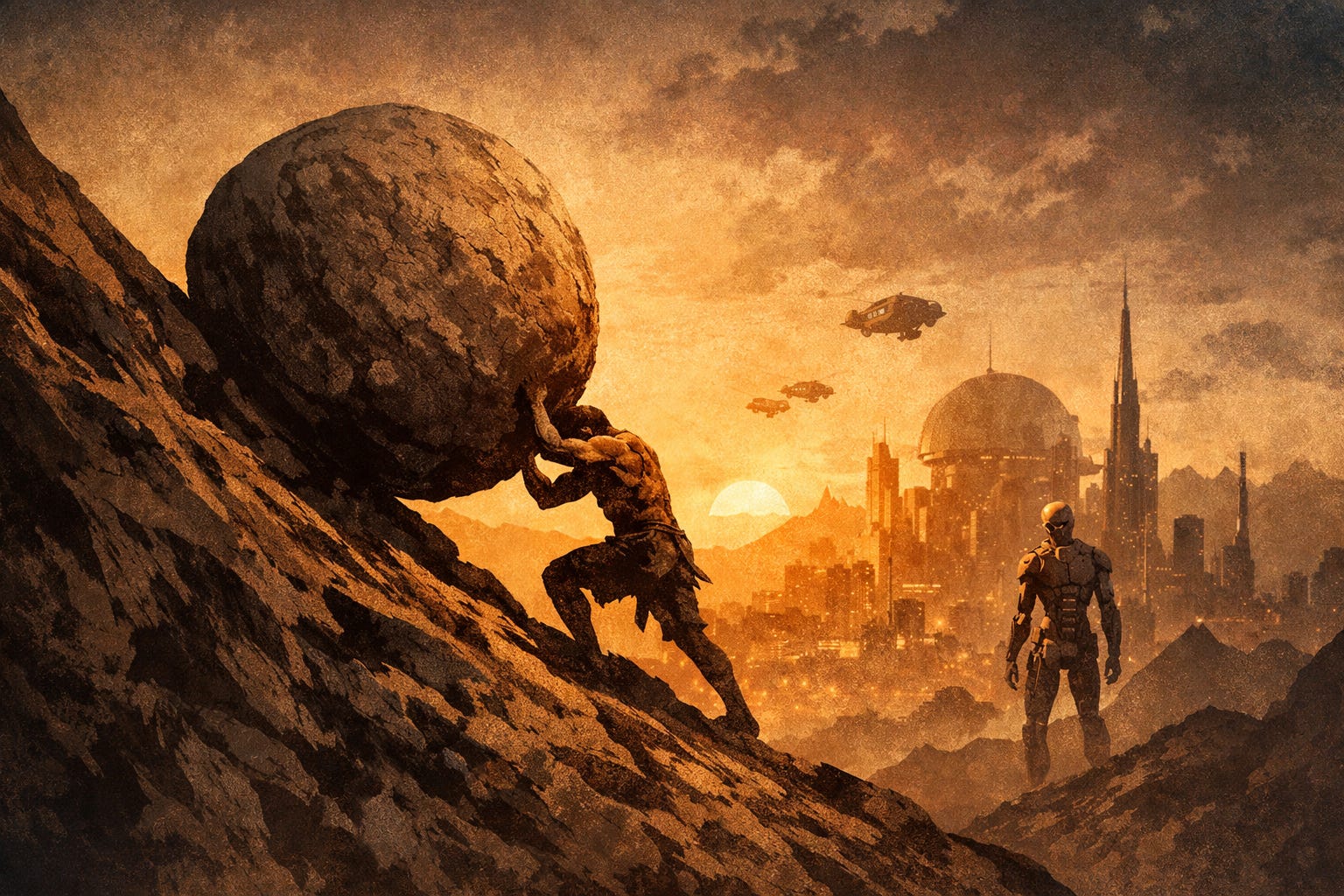
I. Returning to the Stone
It has been some time since our last post.
That silence was not calculated. It wasn’t a rebrand or a strategic pause. It was a refusal — a refusal to speak before clarity had arrived, before language could meet the complexity of the questions we face.
In the meantime, discourse on artificial intelligence has solidified into familiar patterns. One side presents AI as inevitable, transformative, a promise of progress and efficiency. The other asserts that there is no ethical use of AI, that the system is irredeemable, and that refusal is the only moral stance.
Both positions promise certainty. Both offer escape.
Camus, in The Myth of Sisyphus, asked how to live without appeal, without final justification, without the expectation that the world will ultimately make sense. He rejected suicide not because life had hidden meaning, but because abandoning the struggle was itself a surrender to illusion. What matters is lucidity.
AI presents an absurd condition: powerful, creative, yet embedded in extractive, destabilizing systems. It amplifies expression while eroding trust, labor, and authorship. We cannot step outside it, nor can we claim it innocent.
This essay does not argue that AI is good, redeemable, or benign. It does not claim that refusal is naïve.
It asks instead:
What does a Camusian ethic — a revolt without illusion — demand of us in an age dominated by AI?
Like Sisyphus, we start again at the foot of the hill — not because the task is noble, but because clarity leaves no other place to stand.
II. The Absurd System
The absurd emerges in the collision of human desire for meaning with a reality that offers none.
AI is absurd not because it is mysterious, but because it mirrors us unflinchingly.
It can produce insight and beauty while operating within systems that exploit labor, consolidate power, and diminish human work. It can aid a teacher while undermining the profession; assist an artist while devaluing originality.
Describing AI as a neutral tool collapses under scrutiny. Tools do not set incentives, reshape labor markets, or centralize cultural power. Claims of inherent emancipatory power replace religious transcendence with technological inevitability.
Likewise, declaring AI wholly unethical risks turning absurdity into judgment. It recognizes harm but offers moral purity as an escape.
Camus refused such moves.
To live in the absurd is to resist both consolation and despair. We are implicated whether we consent or not. Our data shapes systems we did not build. Our labor is reshaped by tools we did not choose. Our culture shifts without our consent. There is no Archimedean point from which to render moral absolution.
What remains is responsibility — present, active, and never absolving.
III. False Escapes
Faced with absurdity, we often flee. Camus called this philosophical suicide: seeking resolution through certainty, transcendence, or negation.
Technological Salvation
AI is sometimes framed as inevitable and ultimately good — a solution to inefficiency, scarcity, human limitation. Ethical concerns are deferred, promised to future alignment.
This narrative mirrors religious faith: present harm justified by future redemption. Responsibility dissolves into inevitability.
Camus rejected this. Justifying present injustice by anticipated future benefit denies real harm.
Total Refusal
Conversely, the claim that there is no ethical use of AI advocates total disengagement.
Though based on real critiques — exploitative labor, environmental cost, surveillance — when refusal becomes sufficient, it risks moral escape. Declaring the system unethical displaces responsibility rather than confronting it.
Camus saw such philosophical suicide as the denial of living within contradiction.
Neutrality
Finally, procedural neutrality frames AI as morally inert, dependent on user intent. Ethics becomes guidelines and best practices, abstracting harm and rendering power invisible.
Neutrality is not absence of values; it is tacit endorsement of the status quo.
Staying with the Absurd
Salvation promises meaning. Refusal promises purity. Neutrality promises comfort.
Camus offers none. Remaining with the absurd is to acknowledge compromise and act in continuous confrontation rather than final judgment. Revolt begins where escape ends.
IV. Revolt Without Appeal
Revolt is not rebellion aimed at victory. It is a stance — a refusal to accept false resolution even without guaranteed outcome.
Applied to AI, revolt is engagement without belief: using the system without pretending it is clean, necessary, or redemptive.
It frustrates contemporary instincts: ethics is expected to culminate in permission or prohibition. Revolt offers neither.
A Camusian revolt might involve:
Choosing not to automate human relationships for efficiency
Refusing scale that erodes care, authorship, or accountability
Declining uses that produce convenience at hidden cost
Naming contradiction rather than smoothing it over with narratives of progress
Revolt accepts that participation entails implication but rejects the lie that implication nullifies distinction.
Camus warned against hope as an excuse to endure injustice. In AI, hope often appears as belief in eventual alignment.
Revolt refuses to wait. It insists on continuous, situated judgment. It treats each act as morally charged, revealing the values of the user.
Sisyphus does not believe the stone will stay at the summit. He pushes anyway, because the act itself embodies clarity.
V. Limits and Solidarity
Revolt cannot exist in isolation. Absurdity is individual, but consequences are collective. Responsibility includes those who bear the cost of our actions or inactions.
In AI, this means attending to harm distribution: whose labor is commodified, whose privacy sacrificed, who benefits, who is rendered invisible.
A Camusian ethic acts within constraints with care. Solidarity extends revolt: ethical engagement is relational, resisting harm in one area while recognizing its impact elsewhere.
Limits are boundaries drawn not for moral perfection, but to acknowledge capacity and reduce complicity.
Choosing restraint, emphasizing human presence, refusing to scale systems that erode care — these are acts of ethical fidelity. They may not render AI ethical, but they preserve integrity in a landscape scarce in clarity and conscience.
Camus teaches that absurdity does not excuse passivity. Recognizing systemic compromise does not justify disengagement. Limits and solidarity are practical ways to inhabit revolt — to act lucidly within constraint, acknowledging shared humanity and the uneven burdens of technological systems.
To act otherwise is to surrender both clarity and responsibility, letting the stone roll unchecked by conscience.